These occupational therapy fall activities for kids offer fun ways to build skills needed for development and learning. These seasonal activities are a great way to provide sensory input, and they improve gross motor skills and fine motor skills in children.
Fall is such a wonderful time of year! There’s so much to love and embrace about the fall season. (Maybe I love this one a little more than the others because I was born in it?!)
Autumn brings vibrant leaf colors, so many lovely scents, the warm sun and cool crisp air, fresh produce from the garden, and the sounds of football games! It’s the time of year to enjoy the harvest, the soups, some warm beverages, and those easy crockpot meals!
I personally love the smells and visuals that come with fall. The smell of the leaves and campfires. How the bark darkens to make a beautiful contrast against the vibrant autumn leaves. The deeper greens that the evergreens produce against the falling, and dancing orangey leaves.
And as my dad pointed out to me when I was a young traveling professional: the sight of leaves dancing in your rearview or side mirrors as you drive along a country road lined with a wooden fence.
Ahh, I could go on!
Grab your sweaters, flannels, and favorite blankets. Let’s have some fun helping kids naturally learn during this beautiful season!
The occupational therapy fall activities in this post are organized into two categories: 1) fall nature and sensory activities and 2) gross motor activities and fine motor skills activities.
Get ready for some fall fun!
Occupational Therapy Fall Nature & Sensory Activities for Kids
Children end summer fun and adjust to the back to school routines in the fall season. Even though kids just had numerous opportunities for brain boosting summer activities, you can still provide so many sensory play and nature activities in the fall.
Connect kids with the outdoors and nature with fun activities as they learn. Add sensory input during learning. It will enrich their world and improve learning connections in the brain.
Below is a list of fall nature and sensory activities for kids.
Scavenger Hunt
Explore outdoors to find different shapes, colors, and small items in nature. Have kids find objects that relate to learning concepts.
Bring the objects indoors for additional exploration.
Picture Collages
Collect leaves and small sticks for picture collages. Snap sticks and crumple leaves to make letters, shapes, animals, or scenes.
Colorful Leaf Pictures
Find colorful fall leaves for a picture. Use the full leaf or crumple them to make colorful fragments for pictures.
Pumpkin Sensory Activity
There’s no better fall sensory experience than pumpkins! They’re full of textures and an unforgettable smell. Take a field trip to a pumpkin patch.
Encourage child participation in pumpkin carving. Clean it out, sort the flesh, seeds, and strands. Wash and count the seeds. Save the flesh and strands for a sensory bin or craft project (stringy hair) or use the seeds for a picture collage.
Mold a Pumpkin
Use paper machete, molding clay, or play dough to make a pumpkin. Add paint to the paper machete or clay for color and face parts. Use small items or craft objects for the face on the play dough.
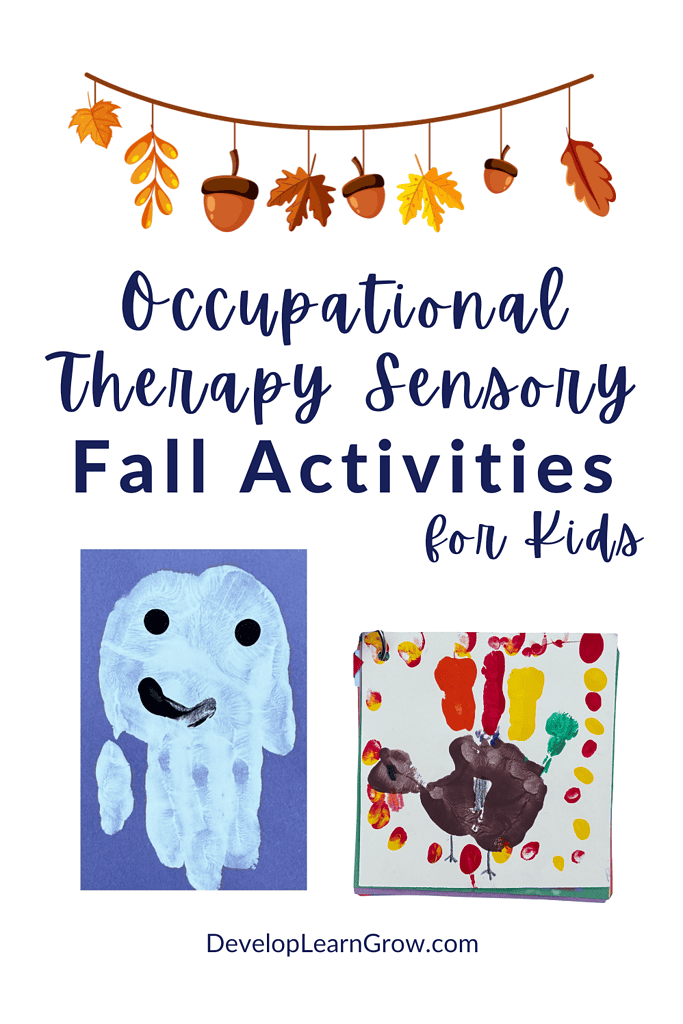
Ghost Handprint
Paint (or have kids paint) white finger paint onto their palm. Keep fingers close together and press onto a dark construction paper background. (See image.)
Turkey Handprint
Spread brown finger paint onto the palm and thumb. Paint other fall colors (red, orange, yellow, green) onto each of the remaining fingers. Press hand onto cream colored paper with the thumb spread away from the other fingers. Add eyes and a wattle. (See image.)
Corn Sensory Bin
Make a bin of dried corn kernels. Hide acorns, fake leaves, candy corn, magnet letters, magnet numbers, etc into the bin.
Fall Sensory Bin
Place leaves, acorns, mini pumpkins, cinnamon sticks, etc for sorting and counting.
Create a holiday bin of spider webs (pillow stuffing or cotton strings) and place items into it for sorting and counting.
Thankful Bin
Create a sensory bin full of leaves for a writing center. Children pull out a leaf with a topic written on it as a writing prompt.
Oatmeal, Apple, and Cinnamon Bin
Place dry oatmeal, apple slices, and cinnamon sticks (or dried cinnamon) into a container or tray. Use for drawing with a finger, or for a sorting bin.
Orange Putty Treasure Hunts
Hide seasonal small objects in putty. Kids use tactile discrimination skills to find the hidden objects.
Fall Playdough
Make your own playdough or add spices such as cloves, cinnamon, or nutmeg. Use it for letter formation or for math manipulatives.
Sink or Float Bins
Use a large bin and fill with soapy water. Add fake leaves, gourds, mini pumpkins, acorns, etc for an experiment. See what sinks and what floats.
Drawing Tray
Place flour (or salt) and cinnamon onto a tray for drawing. Kids use their index finger to practice drawing shapes, letters, numbers, or words into the medium on the tray.
Cinnamon Tactile Drawing
Add cinnamon to shaving cream, cool whip, finger paint, salt, or sand. Practice pre-writing strokes and shapes or practice letter and number formation. Additionally, add cinnamon to paints or other sensory activities.
Rock Painting
Find rocks of different sizes. Clean, dry, and use finger paint! Use your small painted rocks as math counters for a DIY math manipulative.
Leaf Races
Blow leaves across a table with a straw. Have competitions or use it in math for estimating distances. This is a great calming oral sensory activity.
Yard Cleaning
Rake leaves, shovel and scoop into buckets. Teach kids about recycling by creating a compost pile. These are great heavy work activities that offer calming proprioceptive input.
Jump in the leaves for an added sensory experience!
Build a Scarecrow
Use a variety of fall mediums and an old flannel for team building group work. Build a scarecrow with what you have lying around.
Teach children why you’re doing it!
Water Plants
Use pitchers, cans, containers, or a spray bottle to water plants (or maybe propagated plants you’re working on!)
Flying Ghosts
Make a ghost using tissues and crumpled paper inside. (Crumpling paper is great for hand strength.) Tie with string and place on a ring. Hang the ring on ceiling string and blow on the tissue to make the ghost fly!
(That sounded a little Dr. Seuss-ish!)
You can also have children tie the ghost to a popsicle stick or straw for them to hold and gently blow to make it dance. Oral sensory activities like this are calming and organizing for the brain!
Mystery Sock Tactile Game
This is a fun activity that I use often during my occupational therapy sessions. It helps kids with tactile processing and tactile discrimination.
Place fake small objects such as mini pumpkins, ghosts, leaves, sticks, and apples into a clean tube sock. Have kids reach in to either match or identify an object without peeking.
Check out the post, Tactile Learning: Unique Hands on Activities for more information.
Spider Web Tangle
Place spiders into a stretchy, stringy web of blanket filling. Add colors, letters, or words onto the spiders or other objects for learning.
Kids use letters to spell a word, create a sight word, or read a vocab word that they then teach to their peers.
Sit Around a Campfire
Nothing is more relaxing than the sounds of peepers at dusk and the warmth of a fire. Then, the crackling wood and flickering flames. And for an added bonus, the taste and texture of a S’more!
Try this with your children, or encourage it to be a “homework” task for students!
Occupational Therapy Fall Movement and Fine Motor Activities for Kids
The following gross motor activities work on core strength, balance, motor planning, hand-eye coordination, and body control.
The fine motor fall activities help build visual motor skills, bilateral coordination, and strength and dexterity in the small muscles of the hands. Additionally, the fall craft projects listed below work on visual perceptual skills, mindfullness, and creativity!
*Important note: in my descriptions, for the sake of unneeded text, I often just say “paint” or “trace” or “cut” etc… please make sure that your children are doing ALL of the parts of the fine motor activity.
You set it up, the rest is up to the child. Their work does NOT have to, and SHOULD NOT look perfect! It’s the process and their self-esteem that counts! Kids learn from doing. Please just let them move, be, and create as best as they can until they improve skills.
Tree Sways
Improve core strength with a quick stretch through the sides of the body with “tree sways.” Tell children to stand and place their roots in the ground (feet firmly stuck to the floor.) Then, they lift their arms up above their heads. They slowly sway their “branches” to the right. And to the left.
Skate Through a Pumpkin Patch
For a fun motor planning activity, make an indoor obstacle course with pumpkins and “leaf piles” in a pretend corn maze. Have children float like a ghost as they skate on paper plates through the maze paths.
Pumpkin Relay Race
Use small pumpkins and a larger serving spoon for a relay race.
Pass Pumpkins and Gourds
During circle time or morning meeting, pass a pumpkin or gourd around the circle or down a line. This is a fun way to work on following directions and crossing midline.
Have children pass to the next child “with your right hand, behind your back” or “with both hands above your head, left shoulder to right shoulder.”
Roll A Pumpkin Through a Vertical Path
Draw a path on a board or tape a path on a wall. Kids use two hands to roll the pumpkin along the path.
Make it a crossing midline activity with matching letters or objects on either side.
Bowling Games
Roll a toy pumpkin, gourd, corn with husk, etc to knock down blocks of hay (cardboard boxes) or corn stalks (pins with corn stalk around them!)
Acorn Roll
Similar to the pumpkin roll on a vertical path, use a small acorn to follow along a path on a tabletop or large paper.
Use Wikki Stix as a border for your maze paths, or create one with Elmer’s glue.
Apple or Potato Paint Brushes
Slice a small apple or potato in half. Use the flat, sliced side to dip in paint. Stamp or paint with the flat side on a vertical surface. Paint leaves on a large tree, or fill in large bubble letters on a sign or poster. Use a different color for each apple or potato shape.
Paint Mini Pumpkins
Find the perfect pumpkin and paint a face or design. Add yarn or small items to the head to work on pincer grasp. This is great for grasp development.
Colorful Leaf
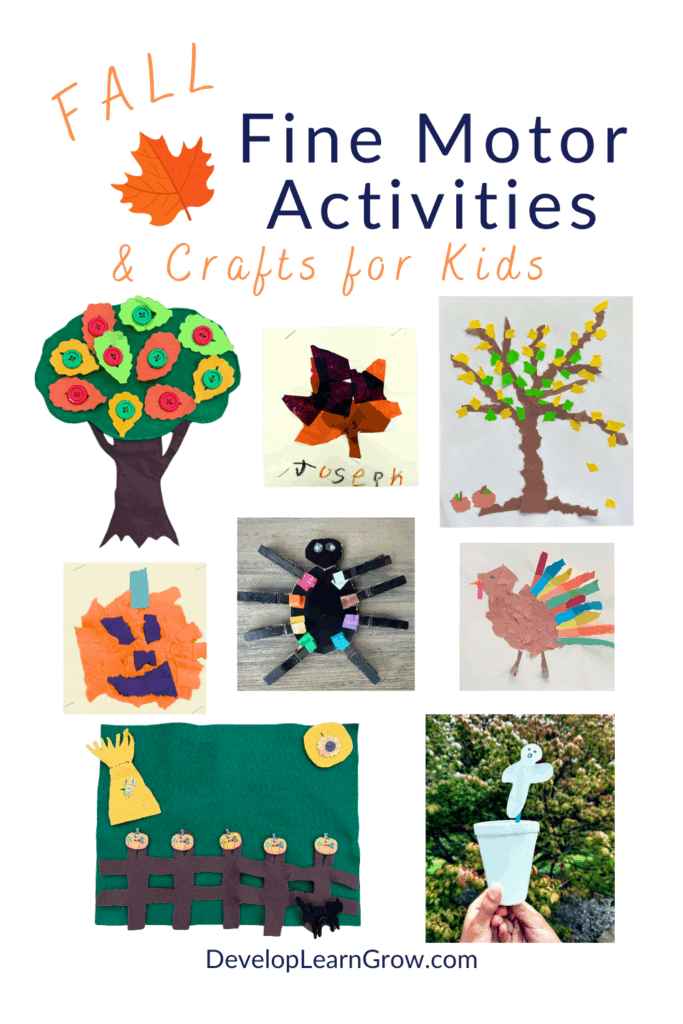
Trace a maple leaf template onto cardstock. Cut it out. Glue fall colored tissue paper squares onto the leaf outline. (See photo.)
Pumpkin Paper Plate
Paint a white paper plate orange with a textured sponge or finger paint. Cut black construction paper shapes to add face parts.
Puffy Ghost
Mix your own puffy paint to fill in a chalk ghost outline on black construction paper. Check out the Puffy Snowman Post for more info
Clothespin Matching Games
Color code or make matching designs to the ends of clothespins. Create templates so that kids can match learning concepts. For example, kids can make spider legs on a spider (see image) or clip vocab words to their definitions.
Peek-A-Boo Ghost
Trace and cut two symmetrical ghost shapes. Add eyes and a mouth to each side. Tape or glue together with a straw secured in between the two ghosts.
Poke a whole in the bottom of a paper or Styrofoam cup. Push the ghost on a straw down into the cup and through the hole. (So that the ghost is hiding in the cup.)
Kids will have a great time holding the cup with one hand, while the straw quickly pushes the ghost out of the top of the cup to scare an adult! And even better, this is a great way to work on bilateral coordination, grading of movements, and grasping skills. (See image.)
3-D Paper Pumpkin
Cut strips of orange construction paper (4-8 depending on the width.) Curve each strip and secure at the tips with a staple, glue, or tape.
Continue to secure the strips until your child has made a 3-D pumpkin. Add a stem and leaf at the top.
Felt Buttoning Picture Activities
Work on buttoning skills with soft felt picture designs. Make trees with apples or leaves, assemble pumpkin pictures, or build a turkey. (See images. And a big thanks to my mom for her great sewing skills!)
Construction Paper Pictures
This simple activity is my go-to for kids in all grade levels. I use it with Pre-K through 5th grade students!
It’s a great mindful activity that works on some basic, but important skills for kids. Simply tear scraps of construction paper to make a picture.
In the fall season, I often have kids make pumpkins, trees, or turkeys. (Refer to image.)
For more details, check out the post Super Simple Fine Motor Activity.
Alphabet Tree
Print or draw a tree with upper or lowercase letters inside apples or leaves. Kids make playdoh mini-balls and then press them onto the letters in the proper sequence.
Acorn Counters
Take away your math manipulatives for the fall season, and use acorns for counters instead.
Scarecrow Learning
Use a paper plate as a hat and a round plain face for the scarecrow. Cut strips of yellow-orangish-brown paper for the hair. Write names, sight words, thoughts of gratitude, definitions, etc onto the hair strands. Or use it in math for math facts and problems.
Spider & Web Weaving
Mold a spider with black pipe cleaners. Make the web using a white paper plate. Have kids use a hole punch around the perimeter of the plate. Then, they string white yarn through the holes in a back and forth pattern across the plate.
Move Objects Through Maze Paths
One of my favorite activities: laminate a maze or place it in a sheet protector with cardstock behind it. Place a magnet on top of the sheet.
Student holds a stronger magnet under the sheet and moves the top magnet through the maze. Tape or draw pictures onto the top magnet! Check out Visual Motor Activity Using Magnets for more info.
Stamp with Leaves
This is great for older students. Paint one side of a leaf and stamp on paper for a textured picture.
For symmetry art, fold the paper in half, place a generous amount of paint on the leaf, stamp, remove, fold, press, and open. Have them describe that they see from the symmetrical art.
Disappearing Ghost
Draw a ghost on a chalkboard, block wall, or brick wall (for a fun vertical activity.) Use a spray bottle to make the ghost disappear. Spray bottles are a great way to build hand strength in kids.
Turkey Hand
This is a good one for preschool students and even older students. Many 2nd and 3rd grade teachers say that their students have a really hard time tracing.
When kids trace their own hand, it requires precise pencil pressure, increased bilateral coordination skills, and crossing midline skills. It’s a simple and quick activity that you can have them practice on the back of any worksheet!
To make the turkey on the hand, add the eye, beak, and wattle to the thumb. Draw legs (or use crafting supplies) and encourage creativity when decorating the feathers.
Thankful Tree
For more tracing practice… make a fun bulletin board with a tree trunk and branches (or just make space for leaves if you’re thinking that’s a disaster for you!)
Kids pick a color, trace a leaf template, and then write something they’re thankful for on the leaf.
More Movement Activities and Art Projects for Kids
Have fun with these fall activities for kids. Keep your children moving now, and throughout the rest of the year. Check out these movement ideas:
- 81 Outdoor Games for Kids at Recess
- 61 Indoor Gross Motor Activities for Kids
- 30 Quick & Easy Movement Activities – No Equipment Needed
For more art projects and crafts for kids: