
Build fine motor skills, visual perception, gross motor skills, and sensory processing in children with fun winter activities. These occupational therapy activities are great for the winter months. Add them to learning and play routines for your preschool and elementary students. And definitely practice them at home!
As an occupational therapist, I love sharing activities that build skills in preschool and elementary students. There are so many opportunities to embed sensory and motor activities into daily routines.
Children’s bodies are currently not developing the way they are meant to. Excessive screen use is interfering with the development of basic skills.
It’s so important to have kids participate in activities that build sensory, gross motor, fine motor, and perceptual skills.
Change up your centers with different activities during the seasons. Children learn better and Improve Memory when they have fun.
Choose occupational therapy activities that help build foundational skills that many children need right now!
Fine Motor and Visual Perceptual Winter Activities
Many teachers share concerns regarding declining fine motor skills and problem solving abilities in children. And as a school-based occupational therapist, I also see it firsthand.
Kids need more practice with fine motor activities in order to build important skills for life and learning. Through Play-Based Learning, they also develop executive function skills.
Use these fun fine motor activities to improve hand strength, visual motor skills, visual perceptual skills, and eye-hand coordination. Get creative with art projects and crafts during the winter season.
Felt Bulletin Board
Offer important Vertical Activities for children with a winter theme on a bulletin board. Decorate a tree, build a snowman, or count and match snowflakes for a math center.
Winter Tree
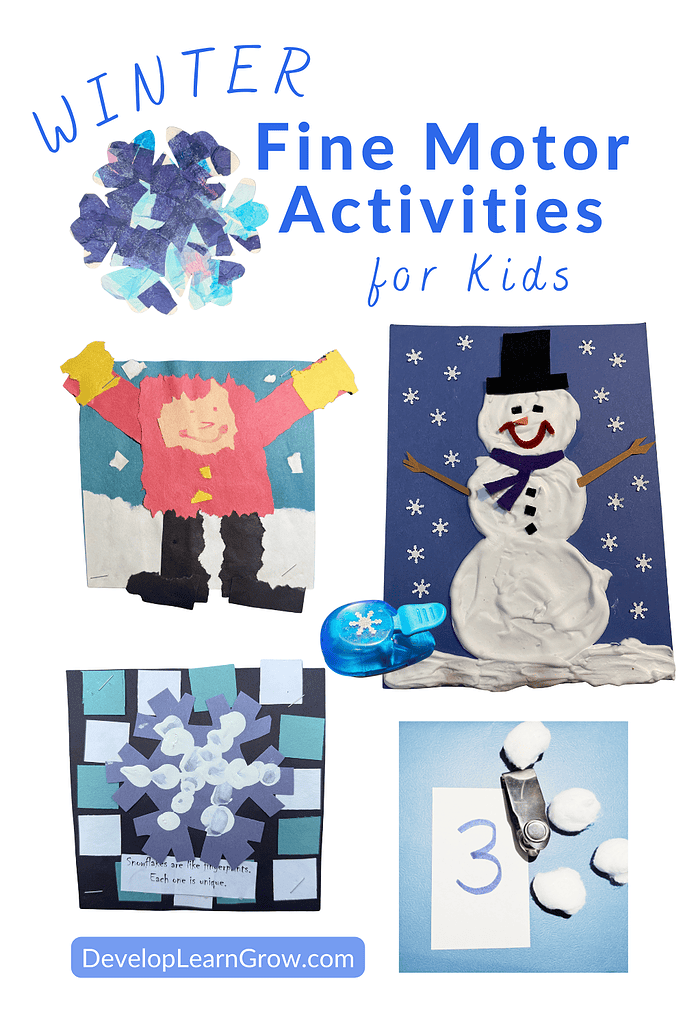
Have children cut strips of green paper into small squares. Build a tree starting with one square at the top, then two, then three, etc. This activity is great for math and for visual perception.
Cotton Snow Balls and Tongs
Use tongs and cotton balls for sorting and counting snowballs. I prefer very small tongs (strawberry hullers) that only allow room for the thumb, index, and middle fingers. This builds hand strength in the fingers needed for pencil grasp.
Trace Candy Canes
Use a candy cane or a template to trace a candy cane. This is a great way to work on Bilateral Coordination skills, Crossing Midline, and visual motor skills. Decorate the candy cane with red and white paint. Or build visual perception to cut angled pieces of paper that fit the candy canes.
Competition with Candy Canes
Build shoulder stability and improve fine motor control with this fun competition. Have preschool or elementary students see how many candy canes they can hold in front of them and hook together. (Just like the Barrel of Monkeys game.)
Glitter Snowflake
Place colored tissue paper squares onto a large snowflake template. Choose different shades of blues for the tissue paper. Paint with clear glue and sprinkle glitter on the top.
Build a Styrofoam Snowman
For a math center, use different sized craft Styrofoam balls and small dowel rods to build a snowman. This is good for size discrimination for young children.
Add dowel rods or strong sticks for the arms. Use small objects such as pegs for the face parts.
Hole Punch Snowflake
For thumb stability, hand strength, and pincer grasp development, use a small craft snowflake hole punch.
Kids build finger and thumb strength when they squeeze the paper punch. Then, they work on pincer grasp and fine motor control as they pick up the snowflakes. They can glue them onto a paper, or use them as counters.
This activity supports pencil grasp development.
Paper Snowflakes
Improve scissor skills and visual perceptual skills while making paper snowflakes. When kids fold the paper, it supports Visual Perception and hand-eye coordination.
Cutting the folded paper offers heavy work for the hands. (And it’s a great way to slow kids down to increase cutting accuracy.) Check out more tips on the Improve Scissor Skills post.
Paint a Winter Theme
Use white paint on dark paper to make a winter scene. Use a small sponge to paint textured snow and a Q-tip to make snowflakes.
Puffy Snow Paint – Make a Snowman or a Winter Picture
Mix shaving cream and Elmer’s glue to make puffy snow paint. Check out the How to Make a Puffy Snowman post for more detailed instructions.
Snowflake Pipe Cleaners
Use small objects such as craft beads or winter confetti to place on pipe cleaners. Twist and bend to make snowflakes.
Spray Snow
Place snow on a tray or build a snow fort outdoors. Add natural food coloring to the water in the spray bottle.
Kids can write or make a picture in the snow. The spray bottle is a great way to build hand strength. And, it’s so much fun for kids!
Clothespin Snowflake Game
During circle time, give every student a clothespin. Laminate a snowflake. Students greet each other as they pass the snowflake around.
But, the challenge is passing it only using the clothespin. This requires problem solving and motor control.
Winter Themed Memory Cards
Improve visual memory with winter memory cards. Play the traditional memory game. Card games are good for fine motor development. And setting up the game requires perceptual skills and problem solving.
The memory cards can also be used for a “what’s missing” game. Partner kids up. They place 3 or 4 cards in front of their partner. Peer looks away (or a folder can be held overtop.) One is removed and the peer guesses which one is missing.
For more creative ideas, check out:
- Easy Educational Art Projects for Elementary Students – This post shares several other ideas for art projects and crafts.
- Super Simple Fine Motor Activity – Tearing Construction Paper – Make a self-portrait in winter clothes, a winter tree, or a winter scene.
- 107+ Easy OT Hand Strengthening Activities & Games for Kids – Find the best toys to promote fine motor development and hand strength.
Sensory and Gross Motor Winter Activities for Kids
Keep kids moving during the winter season. Offer sensory input during outdoor and indoor activities.
Sensory input includes movement, (vestibular input) heavy work activities, (proprioceptive input) and tactile activities.
As an occupational therapist, I can’t stress enough the importance of sensory play for kids. Children need these activities embedded into daily play and learning routines.
Children’s bodies naturally require sensory input for optimal body and brain development. (The Pyramid of Learning shows how fundamental these skills are!)
Build foundational sensory and gross motor skills with these fun winter-themed occupational therapy activities.
Paper Plate Ice Skating
Use two paper plates and have children skate across the floor or down a hallway. Make it more challenging during an obstacle course or relay race.
Additionally, you can use these for a movement pacing lane.
Walk Like a Polar Bear
Transition in between activities by walking like a slow polar bear. This is a great way to provide calming proprioceptive input.
The heavy work through the open palms builds hand strength. Additionally, it is great for core strengthening and shoulder stability needed for fine motor skills.
For more ideas, Weight Bearing Exercises for Kids, Easy & Fun Occupational Therapy Activities.
Roll Like a Snowball
Work on gross motor skills and provide movement and deep pressure input through the body with a forward roll. Practice this on the carpet when transitioning back to the desks.
Flutter Like a Seal
Kids lie on their bellies with arms back, head up, and feet off the floor. This is great for strengthening the back.
Make Snow Angels
Enjoy the cold weather and have some fun making snow angels. This is also great for bilateral coordination skills. Make it a following directions game. (Use your right arm to make a wing. Next, move your left leg. Then, move your left arm. You get the idea!)
This is also a great exercise indoor on the carpet. Encourage kids to keep arms and legs in contact with the floor.
Sled Riding
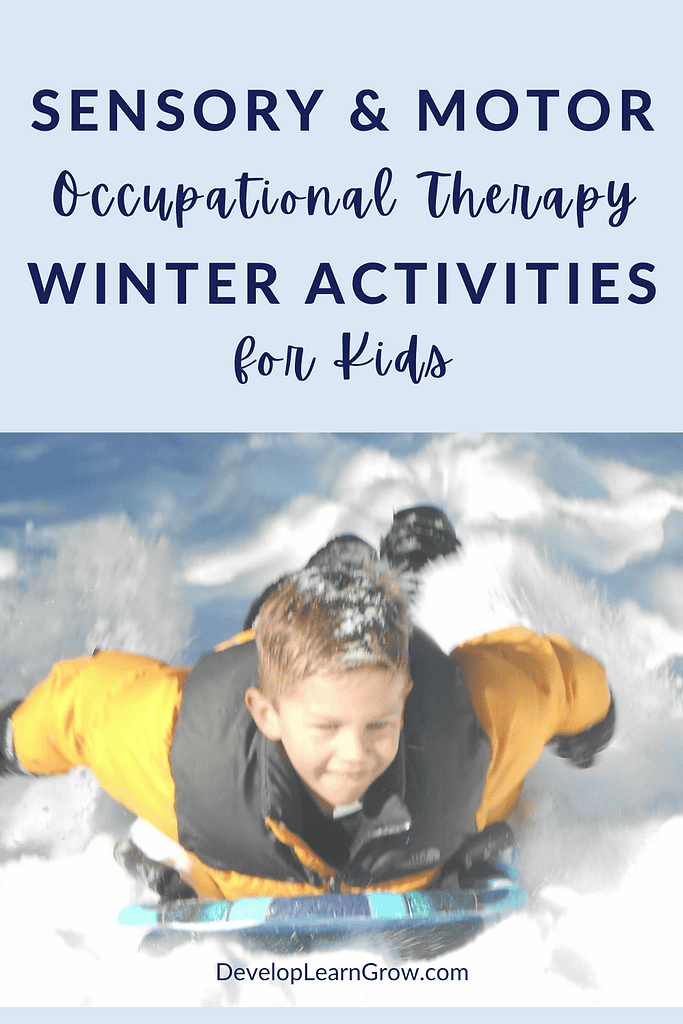
There is no better way to get some fresh cold air and fast linear movement than sled riding! If your space allows, encourage sledding during recess.
Pull a Peer on a Sled
This is a great calming heavy work activity for kids. It builds so much needed strength in the body.
Bring this activity idea indoors on a large carpet space. Or use a scooter or a large plastic bin (and props) for indoor sleigh rides!
Build a Fort or a Snowman
Encourage creativity outdoors in the snow. Have kids build forts or a snowman. This heavy work and the cold fresh air is so good for their brains!
Indoor Snowball Target Game
Build hand strength while crumpling paper (that is ready to be recycled.) Use the “snowballs” to hit a target to work on hand-eye coordination. Or use them to toss back and forth for question and answer games.
For more whole body indoor activities, check out the post 61 Fun Gross Motor Activities for Elementary Indoor Recess.
Please don’t play movies during the winter months, keep kids moving. They’ll behave and attend better!
Pass the Snowball
Bring the cold weather indoors with a bin of snowballs. This is a great sensory activity for the hands.
Have a bowl of warm water handy for students who might want it after!
If you’re not brave enough to bring the snowballs indoors, place a white ball or one wrapped in white yarn in the freezer.
Ice Cube Painting
Place colored sugar sprinkles or Jell-O powder onto white paper. Use an ice cube to paint a design. You can also dip the ice cube into water color paints.
Alternatively, place ice into a bowl and have children paint the ice with a paint brush.
Or, make your own colored ice cubes ahead of time. Add color to the water in each ice cube opening and add a short popsicle stick before freezing.
Snow Sensory Bin
Use a plastic bin for tactile sensory play. Make snowballs, miniature snowmen, or dig, scoop, or spray the snow with colored water. These are great preschool activities.
Sensory Bin with Hidden Objects
Hide letters and numbers into fake snow in a plastic bin. Have children build words or complete math problems. You can also use shredded paper as your fake snow.
Reindeer Handprint
Use brown finger paint for this tactile activity. Have children keep the index, middle, and ring fingers close together. The thumb and pinky will be the ears.
Press onto paper and then turn it upside down so the fingers are pointing downward. Add antlers, google eyes, and a red nose.
Snowflake Fingerprints
Use precut snowflakes on blue paper for younger students. Have older children trace and cut. Add fingerprints to decorate it with white paint. Glue on printed text: “Snowflakes are like fingerprints. Each one is unique.”
Mitten Guessing Game
Place small items inside a mitten that go along with your learning lesson. Children have to guess what they feel without looking.
Or they can try to feel the outside of the mitten and guess one object that’s inside. More information on this can be found on Tactile Learning Activity: Unique Hands On Ideas.
I Spy DIY Snow Globe
Use an empty clear container for an I Spy activity. Fill it mostly with white craft beads or fake snow. Place small items inside.
Preschool children can practice language skills as they find items.
Elementary students can use this in a writing center. They can list what they find. Or, have them work on memory and write sentences about what they saw.
Oral Sensory Glitter Glue Picture
Calm kids with this fun activity. Place Elmer’s glue over a snowflake, snowman, or winter scene picture. Use a straw to gently blow glitter over the glue.
See the post Fun Glitter Art – An Oral Sensory Craft with Added Sparkle for more detailed instructions.
More Movement Activities for Kids During the Winter Season
If you missed the link for the 61 Fun Gross Motor Activities for Elementary Indoor Recess, be sure to check it out. You’ll have several ideas for winter and for rainy days in the spring. And like I said, please don’t play movies or videos! We really need to cut back on Screen Use to help their bodies and brains.
There are also other ideas on the 43 Occupational Therapy Motor Coordination Activities post. When young children don’t have a strong foundation of sensory play, it impacts motor coordination.
When you have opportunities for outdoor recess, 81 Outdoor Games for Recess & Sensory Activities for Kids shares more occupational therapy activities. Encourage kids to use the playground equipment to strengthen their bodies and help with sensory processing.
Oral Sensory Activities Proven to Wake Kids’ Brains are both calming and alerting for children. The mouth provides tons of proprioceptive input for the brain.
In addition, you may have times when you need these 48 Quick & Easy Alerting Sensory Strategies to Get Kids’ Attention.
Alternatively, you’ll also need some calming strategies! Check out Sensory Deep Pressure Tools and Activities to Calm Kids.
*Share this post with parents so that they can practice these occupational therapy activities during winter break.